|
|
 |
|
|
Global Warming or Climate Change
|
| |
| Global warming drives climate change. Global warming is occurring at a faster rate each decade. |
In
the UK we have seen 4 out of 5 of the hottest years ever recorded
over a 330-year period in the last 10 years. These are startling
statistics. This warming is due, at least in part, to the increasing
concentrations of greenhouse gases in the atmosphere.
The world is now warmer than at any time since the last Ice Age, and warming up faster than at any time in the last 500 million years.
Global
warming is caused by a blanket of 'greenhouse gases' building
up around the earth trapping heat from the sun. The earth is
kept warm and able to support life by the solar energy from
the sun. This energy arrives in the form of short wave radiation
most of which passes through the atmosphere to warm the earth's
surface. The earth must be able to return energy into space
at the same rate at which it absorbs energy in order not to
overheat.
The energy being returned to space is in the form of infra-red
radiation and does not pass directly through the atmosphere.
|
Above
the atmosphere, the stratosphere and mesosphere are cooling
faster than anybody thought. The heat trapped by the greenhouse
gases in the lower troposhere causes the cooling. This is called
radioative cooling and may be the "miner's canary" - the latest
and largest sign that things are wrong. The cooling also creates
more ice particles encouraging further ozone depletion.
Lots of processes that influence the climate occur as the energy
is transported through the atmosphere, it is absorbed by water
vapour, carbon dioxide, methane, nitrous oxide and other natural
'greenhouse gases'. These gases act like a blanket around the
earth. |
|
Human activity is adding to these greenhouse gases. During the last
two hundred years vast stores of coal, oil and gas have been burnt that
took millions of years to form. We have burnt fossil fuels faster
than ever before releasing lots of carbon dioxide. Methane is mainly emitted as a by-product of oil wells - as 'natural gas.Nitrous
oxide are emitted when nitrogen fertilsers break down. The same fertilisers need vast amounts of energy - by the Haber-Bosch process - to make.
The
main greenhouses gases are :
- Carbon dioxide mainly from burning fossil fuels.
- Chlorofluorocarbons (CFCs) used for propellants, foam
plastics, refrigerants and solvents
- Nitrous oxides mainly from fossil fuels, industries, households,
cement manufacture and burning rainforests
- Methane from cattle ranching, coal mines and paddy fields
|
Each year
the world pumps about 31,000 million tonnes of carbon and about 250
million tonnes of methane into the atmosphere. Vegetation and oceans
absorb approximately half the carbon and 4/5ths of the methane produced,
the remainder contribute to climate change and global warming.
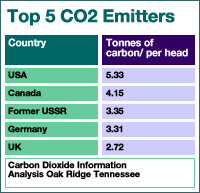
| Industrialised
regions such as Europe, North America and Japan have been responsible
for most of the increase in greenhouse gases by the energy used
to create and maintain the wealth and standard of living. More
people are demanding better food, cleaner water, more electricity,
more consumer goods increasing the demand for even more energy
use. Developing countries want economic growth, the ability
to expand their industries and their people aspire to a quality
of life comparable with developed nations. |
|
|
S
People are realising that the consequences of what was happening would
affect the world long before the seas started to rise. The mixture
of possible events is called climate change.
Climate changes could have enormous consequences such as:
- food shortages as crops fail as a result of shorter wet winters
and long dry summers
- violent storms and more hurricanes
- new pests and diseases
- melting of icecaps
- flooding of low lying areas as sea levels rise
- extinction of many plants and animals as conditions change.
There
are many arguments about climate change. This is not surprising as
there are many vested interests in the debate.
|
Findings
from Britain's Hadley Centre for Climate Change were presented to
170 countries at the Fourth UN Conference of Parties in Buenos Aires.
They showed that parts of the Amazon will be desert by 2050, threatening
the world with an unstoppable greenhouse effect. The computer at the
Hadley Centre shows the earth is heating up fast.
Among the findings are :
- Land
temperatures will go up 6C by the end of the next century
- The
number of people on the coast subject to flooding will rise from
5 million now to 100 million by 2050
- Another
30 million people will be hungry in 50 years because of drought
in Africa
- An
extra 170 million people will live in countries with extreme water
shortages
New calculations make far better estimates for ocean currents.
El Nino and latterly La Ninya have been stronger and longer than any
previous Pacific climate changes.
UK Affects
Under
the Climate Change Act 2008
the UK is legally required to adapt to climate change. The government is required to produce a climate change risk assessment to identify risks and a five-yearly national adaptation programme setting out how it will address these risks.
The third National Adaptation Programme (NAP3) was published in July 2023, and sets out actions that the government will take over the next five year covering the period from 2023 to 2028.
These actions include plans to increase the resilience of infrastructure to increasing temperature extremes, investment in the natural environment and shifts in crops and agriculture, changes that will need to be made to the built environment to protect public health, and shifts in business practices. Wider cross-cutting risks include impacts and adaptations required for supply chains, trade and finance.
The principle impacts will be:
- Soil in the south become more droughty
- Wildlife migrate north
- Arable areas likely to move north
- Forest species increase in north, but beech in the south may
die out
- Higher wind speeds will affect the design industry
- Increased claims for insurers
- Increasing incidence of infectious diseases and heat induced
deaths.
UN response
The Intergovernmental Panel on Climate Change (IPCC) was established under the United Nations General Assembly (UNEP). They assess the evidence and present their finding to a series of UN Conferences under the UN Convention on Climate Change.
Under the 'Kyoto Protocol' countries are set various targets to reduce emissions across the world. However, the USA, Australia, and now Russia are not ratifying the protocol. This means, despite EU pressure, 'Kyoto' is unlikely to have much effect.
What to do instead? Check the NEF "Free Riding on the Climate". They propose using the WTO to challenge those economies that have the hidden 'subsidies' of not meeting these targets.
|
|
For
More Information:
Global Warming
UK government's "Climate Change"
|


